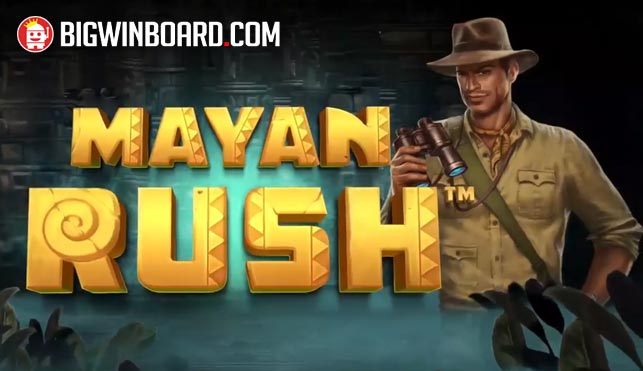
Mayan Rush: Slot Overview
In a move that seems unusually bold, Stakelogic has essentially mirrored Yggdrasil’s 2017 smash Valley of the Gods, swapping the theme for a Central American setting. The finished product, Mayan Rush, includes almost everything the original offered, blocker tile removal mechanic included. On top of that, there’s a Super Stake option that’s a bit more contentious than the norm. It’s not exactly a society-wide controversy, but it is something worth weighing up before you start staking your bankroll.
If you’ve tried Valley of the Gods, or its sequel Valley of the Gods 2, Mayan Rush will look instantly recognisable once it loads up. You play on a 1-3-5-3-1 reel arrangement, with the rest of the positions on the 5-reel grid blocked at the start. The aim is to clear those blockers by hitting winning combinations, which expands the default paylines from 45 up to 3,125 once the full grid has opened.
Beyond relocating the action from Egypt to Central America, Stakelogic also adds a bit of character by introducing a pair of adventurers. One is an Indiana Jones-style figure (more Vince Vaughan than Harrison Ford), and the other is his partner – or maybe the other way around. Whether they’re family, co-workers, or something else entirely is left unclear, so you can make your own call. As for which game looks better, that’s down to taste, although Mayan Rush does appear a touch sharper, which makes sense given the years between releases.
You can take part in the Mayan expedition on any device, with stakes ranging from 25 p/c to $/€25 per spin. That’s the standard setup, at least. Turning on the Super Stake feature raises the cost while offering an advantage – explained in detail below. There’s no indication whether Super Stake changes the RTP, with the default theoretical return set at 96.05%. Either way, the high volatility made Mayan Rush feel extremely swingy in testing. Long stretches of base game blocker clearing went by, broken up only occasionally by Rush Mode moments after the blockers finally dropped.
The symbol set features 6 low-paying golden jewelled icons in different animal-like shapes, while the premium symbols are two Mayan characters: the male adventurer and the female. Five-of-a-kind wins with the top symbols pay out 10 to 20 times the bet. As in Valley of the Gods, there’s no wild.
Mayan Rush: Slot Features
The bulk of play happens in the base game, where you work on clearing blocker tiles. If you manage to remove them all within a sequence, you trigger Rush Mode. During Rush Mode, symbols are linked either to a multiplier totem on the left or a life totem on the right. Their colour is what differentiates them. The multiplier totem starts at x2 and the life totem at 1. When winning combinations hit, the winning symbols involved fill the associated totem’s meter. Gathering 5 symbols boosts the relevant totem value, while losing spins reduce the life totem by one. Respins continue until the life totem reaches zero, at which point Rush Mode finishes.
The second feature is Super Stake. It’s a familiar Stakelogic inclusion, typically offering a specific perk in exchange for a higher price. In Mayan Rush, switching on Super Stake doubles the base bet. For that extra outlay, on a random losing spin, 3 respins can be granted. When they begin, a coin symbol lands in the centre of the middle reel. These coin symbols remove blocker tiles above and below their position. Every time a coin symbol appears, the respins are restored to 3. If all blocker symbols are cleared, coin symbol values are multiplied by x2. If 25 coin symbols are visible, their values are multiplied by x5. The feature ends once the reels are full of coins, or when you run out of respins.
Finally, players may also be able to use a gamble feature. This is the usual pick-the-colour or card-suit option to double or quadruple your win.
Mayan Rush: Slot Verdict
Mayan Rush is the kind of imitation slot that makes you think, wow, that’s audacious. Usually it’s an obscure developer chasing someone else’s success, or a questionable outfit short on original concepts doing the copying. Stakelogic doesn’t fit either category, which makes the whole thing even more puzzling. Yes, ideas circulate between studios all the time, but it’s still surprising to see such a direct lift from a well-known provider.
With that said, the game delivers the same rollercoaster as its inspiration. The blocker mechanic can be as annoying as it is exciting. Annoying because you’ll often get close without quite clearing everything, or you’ll finally reach Rush Mode only to see it die out after one, maybe two, spins. But when it clicks, the bonus can build real momentum. In those moments, big wins should be possible in theory, although the exact maximum hadn’t been disclosed at the time of writing.
The biggest difference is the Super Stake feature, which does add a new twist, but you’re paying for it. Doubling your stake is a hefty jump as well. More often, Super Stake improves something already present, such as making free spins easier to trigger or similar. Paying double for access to a feature you otherwise wouldn’t see feels slightly questionable. It might prove popular, but it’s a significant extra cost to plan around.
So, to wrap it up: Mayan Rush is essentially Valley of the Gods re-themed for a night in the Yucatan Peninsula around 750 AD. If that doesn’t bother you, it offers much the same excitement as Yggdrasil’s classic—possibly even more—though some of those thrills come at a notably higher price.
-
ProviderStakelogic
-
RTP96.05% (Default)
-
VolatilityHigh
-
Reels5
-
Rows1-3-5-3-1
-
Paylines45-3,125
-
Min/Max Bet0.25/25
-
Max WinN/A
-
Hit FreqN/A
-
Release DateT.B.A
Recommended games
-
 Big Sugar BonanzaRTP: 96.01% | 94%
 -
 Fruit StormRTP: 95.85%
 -
 Book of CleopatraRTP: 96.21% (Default)
 -
 Snowflake SorceryRTP: 96.00% | 95.48% | 93.81% | 89.95% | 87.97%
 -
 Hot ChilliwaysRTP: 96.18%
 -
 Space StallionRTP: 96.1% (Default)
 -
 Multi Joker PopWinsRTP: 96% | 94% | 90% | 88%
 -
 Black Gold 2 MegawaysRTP: 96.01% | 94.01% | 92.01%